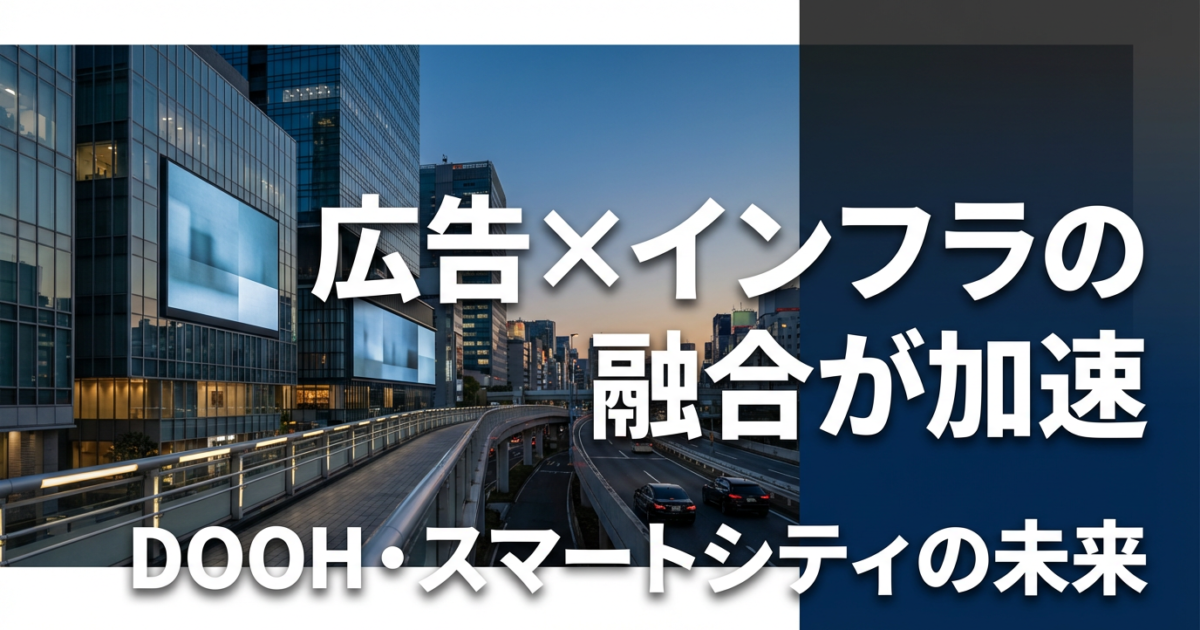
In 2026, the boundary between the advertising and infrastructure industries is rapidly dissolving. Traditionally, advertising centered on media buying and creative production, but now digital signage, smart city initiatives, and integration with transportation infrastructure are emerging as the new battlegrounds.
The Rapid Growth of DOOH and Its Fusion with Urban Infrastructure
The digital out-of-home (DOOH) market recorded a 23% year-over-year increase in 2025. Particularly noteworthy is the rise of “real-time contextual advertising” powered by integration with transit IC cards and mobile payment data. Systems that automatically optimize digital signage content in station concourses based on time of day, weather, and passenger volume have moved well beyond the experimental stage.
In the smart station initiatives promoted by Tokyo Metro and JR East, advertising revenue models are designed to partially fund infrastructure maintenance and renewal costs, forming a new ecosystem where advertising and infrastructure are mutually dependent.
Infrastructure Investment as Brand Experience
Another trend is the approach where companies build brand experiences by investing in infrastructure itself. As demonstrated by Google’s Sidewalk Labs and Toyota’s Woven City, it is no longer unusual for technology companies to participate in urban design.
For advertising agencies and branding studios, this represents a structural shift that goes beyond mere trend-watching. What clients demand is not a “media plan” but a “blueprint for brands to exist naturally within the flow of daily life.” At ASTER, we have been supporting brand strategy development in multiple urban development projects, and demand in this area is steadily growing.
The Skill Set Required in the Advertising × Infrastructure Era
This shift is also affecting the skill sets required of people working in the advertising industry. In addition to conventional marketing knowledge, literacy in urban planning, architecture, data science, and IoT is becoming indispensable.
The Asia-Pacific region in particular, where rapid urbanization and digital infrastructure development are progressing simultaneously, is seen as the market where the fusion of advertising and infrastructure will accelerate the most. In growing cities such as Bangkok, Jakarta, and Manila, there is strong interest in integrated advertising-infrastructure approaches by Japanese companies, making this an area where ASTER’s three-office structure across Tokyo, Hiroshima, and Bangkok is a key advantage.
Outlook
Through the latter half of 2026, the fusion of advertising and infrastructure will continue to accelerate. The key lies not so much in technological evolution itself, but in the creative power to organically connect “the movement of people” with “brand presence.” At ASTER, we will continue to deliver insights from the front lines of this domain.