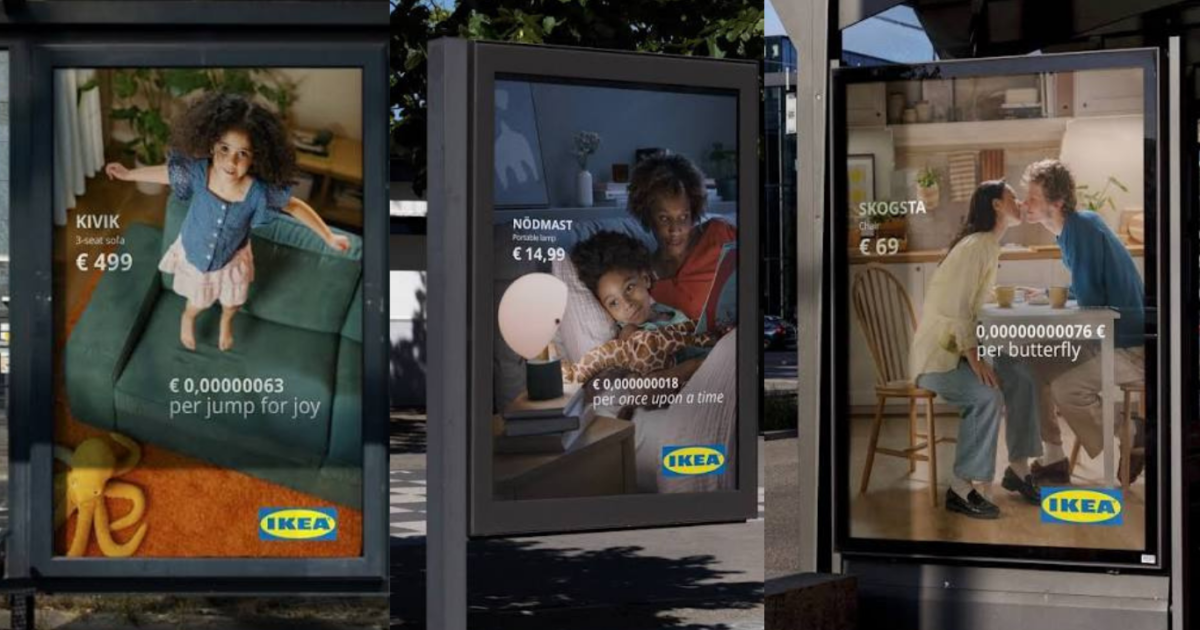
“It’s cheap.” In the middle of a discount war, every retailer is desperate to strip a zero off the price tag. IKEA Belgium went the other way and added one. They priced not the product, but the fleeting happiness the product creates. This quiet move — refusing to fight on either price or features — contains a structure that works especially well for smaller companies who cannot win a war of attrition against the giants.
What happened
In August 2026, IKEA Belgium worked with Ogilvy Social Lab Brussels on an outdoor and print campaign that priced “not the product, but the moment the product makes possible.”
Each ad carried a real product and its normal price, alongside a second, absurdly granular price. A sofa: €0.00000063 per jump for joy. A dog toy: €0.0000024 per tail wag. A bedside lamp: €0.000000018 per bedtime story. A chair: €0.00000000076 per butterfly (spotted by a child).
While every retailer was shaving digits off price tags, IKEA alone went the opposite way and added zeros. The creative director noted: in a price war you normally remove zeros — we added them; this is what happens when you let creatives do the pricing. Trade press including The Drum and Famous Campaigns picked it up.
Why it worked
The trick sits in one place. They quietly stepped off the battlefield of “cheapness” and re-divided the price by an emotional outcome, into a value per occurrence.
To convey the same “cheap,” saying “9,900 yen” drags you into a numerical comparison with competitors. But the moment someone says “€0.00000063 per jump for joy,” people stop thinking about price and start imagining the days they will spend with the thing. And the impossible string of zeros is itself the thing to react to — it makes you look twice and ask what the arithmetic even was. Laughter and agreement arrive together. By inverting the manoeuvre every player in the industry performs (discount, remove a zero), the move itself became the talkability engine.
How a smaller company can use this
“We only ever get compared on price.” Then step off the price battlefield along with the worry. Re-divide your product or service so it is shown not as a sum of money, but as a cost per outcome the customer receives.
For sales support, not “X per month” but “X per meeting.” For recruiting support, “the cost of one hire, divided by the days that person will work after joining, is X per day.” For cleaning or maintenance, “the cost of preventing one incident is X per operating hour.” Simply changing the denominator from a sum of money to the customer’s happy moments or avoided losses turns a contest about expensive-versus-cheap into a contest about worth-it-versus-not.
The point is not precise cost accounting but the presentation of the division. Remind the customer that what they are actually buying is not the product but the outcome beyond it. Dividing the same number costs far less, and works far better, than discounting yourself into exhaustion.
In short
IKEA retold the obvious claim of cheapness by adding zeros to the price tag rather than removing them. Step off the price war and re-price the moments the product creates. This structure is easiest to reproduce precisely for the smaller companies who cannot trade blows with the giants.
At ASTER we break down more than 100 campaigns like this to the structure of why they worked, and translate them into your industry and your price list. How could your quotes and rate card be rebuilt around value per occurrence? Let’s take stock together.
(Structural breakdowns and a case archive are available on request. Please get in touch.)