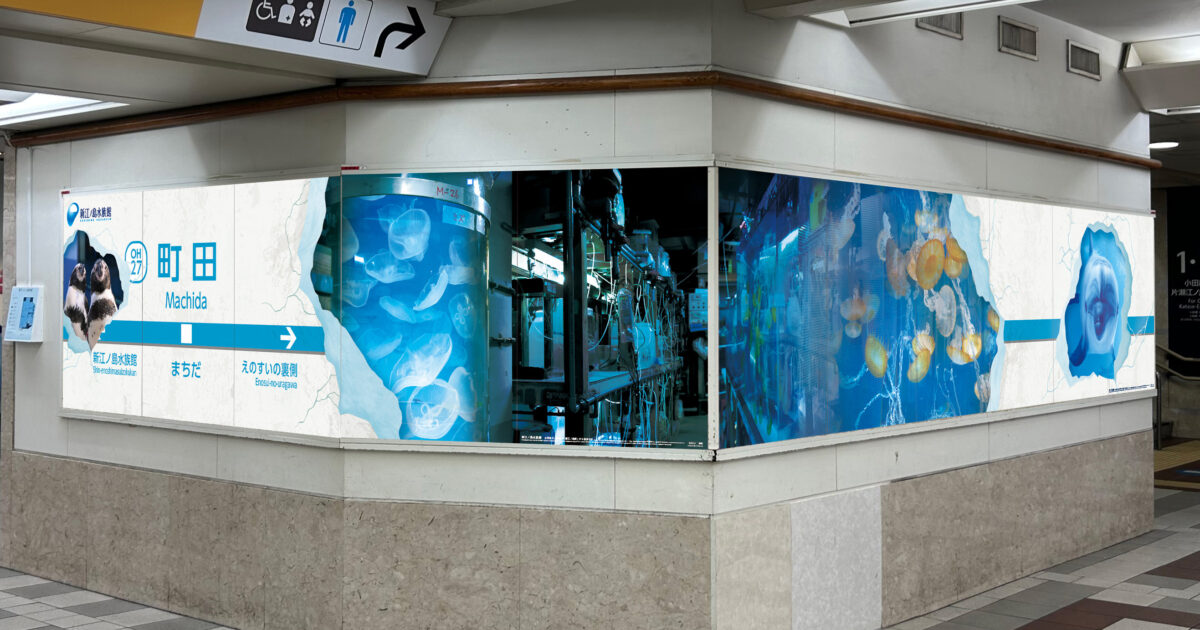
You can attract customers without building a new tourist spot. The Enoshima Aquarium proved it, staging its campaign at Machida Station—far from Enoshima. It rewrote the “meaning” of a station everyone passes through every day with a single line of copy. Let’s break down a “template” that works especially for small and midsize companies based in the suburbs or the regions.
What happened
From July 13 to 26, 2026, the Enoshima Aquarium (“Enosui”) took over Odakyu’s Machida Station. The copy it raised: “Machida Station leads to the Enoshima Aquarium.” Machida is a town that’s by no means close to Enoshima—you have to transfer trains. Over that everyday space of commuting to work and school, it laid the story of a “gateway” to the aquarium.
What was even more skillful was what it showed. Not pretty exhibits or photos of the stars, but a device to peek at the “behind-the-scenes of animal care (the backyard)” that visitors normally can’t see. It also tied into plans like limited nighttime opening, and became a talking point on social media—”so cute,” “I want to go.”
Why it worked
The trick is two-tiered. First, it declared an unrelated everyday station to be “the gateway that leads to that aquarium” through a story, rewriting the meaning of a familiar place. The unexpected connection of “this station is linked to that place” stimulates the imagination all on its own.
Second, it gave a limited reveal of the “behind the scenes” rather than the public face. The rarity of the normally-unseen backstage of animal care—not exhibits anyone can see—strongly drew out the desire to “see it, go there.” What’s masterful is that, rather than hiding the distance or the everyday-ness, it made them the very starting point of the staging. It didn’t build a new tourist destination. It merely rewrote the “meaning” of an existing station through story.
How a small business can use this
“We’re not a famous tourist facility”—that’s fine. Strip it to the structure and neither scale nor location matters. Take an “unrelated place customers pass through daily” that’s far from your base, declare through a story that it’s “a gateway that leads there,” and show the “behind the scenes” rather than the public face.
Take a suburban factory or store. Build a bridge with a story at the nearest station or shopping street: “◯◯ Station leads to the △△ factory.” And what you show is not the finished product, but the “behind the scenes” of the production line or worksite. Or a company rooted in its local area. Connect a familiar building or piece of equipment in town with a story—”this ◯◯ began with our work”—and reveal the normally-unseen backstage of it.
The common thread is: rather than hiding a locational disadvantage (far, plain, inconspicuous), flip it into an asset through story. The distance and the everyday-ness themselves become weapons of staging.
In summary
What Enosui did was declare a station people pass daily to be “the gateway to that aquarium,” and draw visits with the rarity of the behind-the-scenes. It built no new place. It merely rewrote the meaning of an existing everyday. This template is, if anything, easier to reproduce for small businesses based in the suburbs or the regions.
At ASTER, we break down more than 100 talked-about ads to the structure of “why it worked,” and translate that into your industry. How could you turn your location’s “disadvantage” into an asset through story? Shall we take stock together?
(We have explainer materials on these structures and a collection of past cases ready. Feel free to get in touch.)