Twelve tons of chocolate—stolen, all at once. Normally this is the kind of accident where the PR team bows its head and moves on. But KitKat turned it into news around the world. It told customers, “Your KitKat might be stolen goods,” and had them check the code on the package. The result: roughly ¥22.4 billion in earned media value in ten days. Hidden in this single move is a “template” that small and midsize companies can apply directly to hiring, complaint handling, and covering staff shortages. Let’s break it down step by step.
What happened
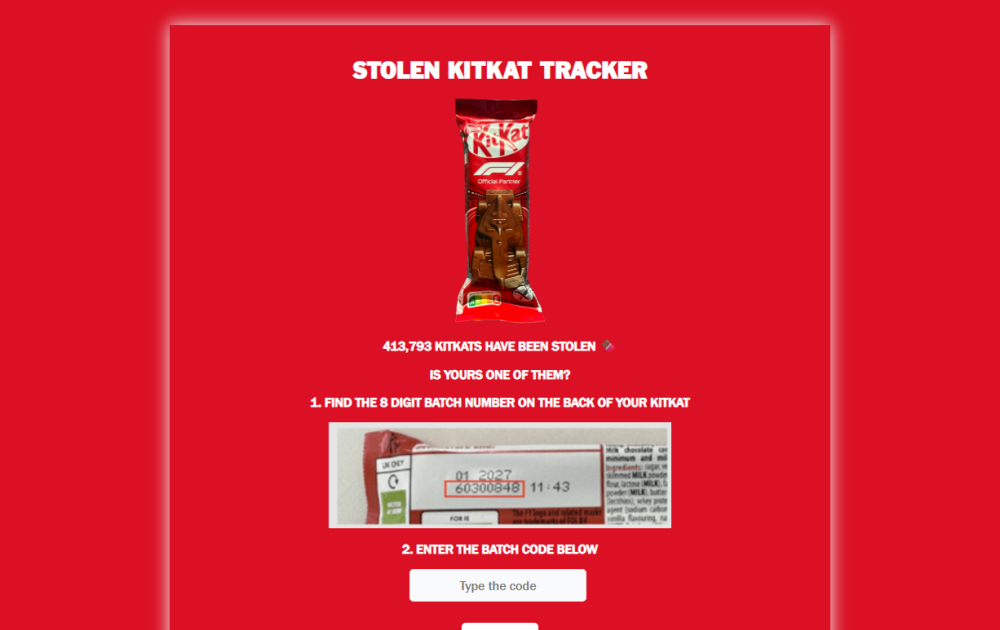
Just before Easter 2026, a shipment of limited-edition KitKats in transit from Italy to Poland was stolen—truck and all. The count: 413,793 bars, weighing twelve tons. And these were no ordinary chocolates. They were limited race-season models shaped like F1 cars, sculpted down to the wings and tires—collector’s items, gone in a single haul.
An ordinary company would quietly settle it through insurance, issue a low-key notice that “some products experienced a distribution issue,” and close the curtain. Making an incident look small is, after all, the conventional wisdom of PR.
How the brand moved
KitKat (Nestlé) did the opposite. Far from hiding the incident, it announced it openly and launched the “Stolen KitKat Tracker.” Consumers could enter the batch number of the KitKat they had bought and check whether it belonged to a stolen lot. In other words, it turned every single customer into a “stolen-goods hunter.”
“Your KitKat might be stolen goods”—that one line turned a mere snack into a detective game. On social media, posts saying “I checked mine” chained together, and coverage begat coverage. In ten days it spread to 93 countries and regions, commanding a 31% share of voice on the topic, about $224 million in earned media, and 2.2 million engagements. The campaign won the Grand Prix in the PR category at Cannes Lions 2026.
Why it worked
The trick comes down to one thing: it flipped the crisis from something to “hide” into a “device for participation.”
Hide an accident and it stays just an accident. At best you “avoid a backlash”—no upside is created. But KitKat pulled customers from bystanders into participants. People cannot stay quiet about a story they get to take part in. “I want to check whether mine is okay,” “This is fun, I’ll tell a friend”—that impulse became the engine of the spread. Even media jaded by constant coverage could not ignore it. KitKat did not buy advertising; it went out to get reported on.
PR that hides is defense—”returning a minus to zero.” PR that invites participation is offense—”turning a minus into a plus.” The same crisis flips its sign depending on the design.
How a small business can use this
“We are never going to have twelve tons of chocolate stolen”—true. But strip it down to the structure and scale is irrelevant. Do not hide the inconvenient fact; reshape it into something the other side can take part in. This works on any front.
Take hiring. If you are short-handed, instead of quietly posting a slot on a job site, put it out as a search: “Looking for a craftsperson who can do ◯◯. Reward for information.” It stops being a job ad that waits for applicants and becomes one that makes the people around you want to act—”I know someone.” The posting itself becomes a talking point, and can even get picked up by the press.
Or complaints and mistakes. The more you try to make trouble look small, the worse it tangles later. Instead, show first—honestly and concretely—”what happened, and what we are doing about it now.” Companies that make their sincerity almost excessively visible have, as a result, gained fans (Garigari-kun’s commercial squarely apologizing for a price hike is a prime example).
Or a vacancy, or a delayed schedule. Rather than papering it over, open up the situation and pull people in: “Help us think this through.” The more stakeholders you create, the more allies you gain.
The common thread is shifting the subject from “us” to “the customer and the public.” Instead of showing, make them search; instead of telling, make them participate. That alone, and the spread starts happening on its own.
In summary
What KitKat did was crisis management turned inside out. Hide it and it is an accident; invite participation and it is content. This flip of sign is reproducible without chocolate, and without being a big company. If anything, a small business with a human face gets even more out of “showing it honestly.”
At ASTER, we break down more than 100 talked-about ads to the structure of “why it worked,” and translate that into your industry. Shall we take stock together of how to structure your own material so that it works?
(We have explainer materials on these structures and a collection of past cases ready. Feel free to get in touch.)