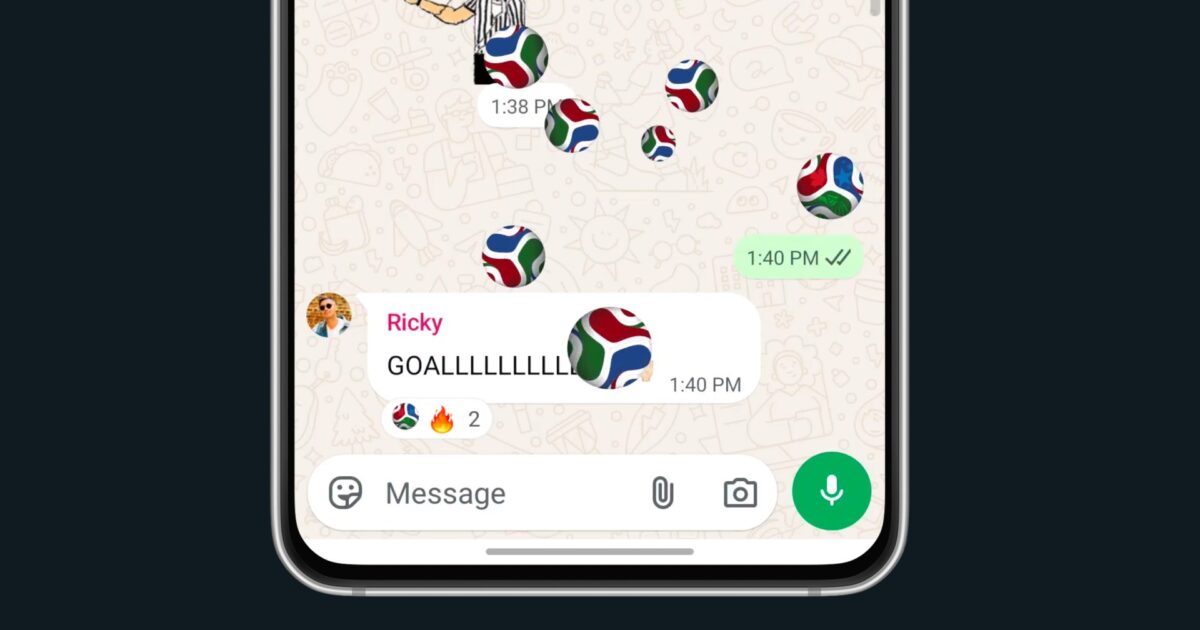
When launching advertising we default to asking where to place it. adidas built no new ad space at all. It replaced the football emoji that people around the world type unconsciously every day with the image of its own product. This move — taking maximum reach with almost no media spend — contains a structure that works especially well for smaller companies with thin advertising budgets.
What happened
On 8 June 2026, adidas partnered with WhatsApp, one of the world’s largest messaging apps, to replace the appearance of the football emoji (⚽) in the app with the design of “Trionda,” the official ball of the 2026 FIFA World Cup. From then on, sending a football emoji on WhatsApp displayed the official ball on everyone’s screen.
The substitution ran for the whole tournament (104 matches across the US, Canada and Mexico). It is said to be the first partnership of its kind between an official ball maker and a messaging app. Talking about a match, arranging to meet, a word of encouragement — in the conversations fans have every day, every send sent the official ball across everybody’s chat screen. Business Upturn and City Magazine were among those who reported it.
Why it worked
The trick sits in one place. Rather than building a new ad space, they temporarily hijacked a standard component people worldwide use unconsciously every day — a default emoji — creating a state in which the advertisement replays every time it is used.
Ordinary advertising puts people on guard the moment they feel they are being shown something. But when the emoji you sent yourself is the official ball, nobody thinks they have seen an advertisement. And yet the product meets everyone’s eyes every time football comes up. By riding the most basic component of a platform, adidas obtained global-scale repeat contact without enormous media spend. There is nothing flashy about it. But the idea that a daily gesture itself becomes the advertisement is powerful.
How a smaller company can use this
“We don’t have a World Cup or WhatsApp.” True. But strip it to the structure and scale becomes irrelevant. Find the standard symbols and boilerplate your customers and staff use unconsciously every day, and load your message onto them temporarily.
The nearest one to hand is every employee’s email signature. Unify one line of everyone’s signature into this month’s recruitment hook or campaign message. Every time your staff correspond, it flows across a client’s screen — a recruitment medium with zero media cost. There are others: the boilerplate footer on invoices and delivery notes, the hold music on your phone system, the greeting message on your official chat account, your quotation template. Each is a standard component of your own that somebody sees every single day, and each is sitting vacant as an ad space.
The common thread: rather than buying a new advertising slot, ride the daily gestures and boilerplate that already exist. Ad space is faster and cheaper to borrow without building than it is to go looking for.
In short
Instead of building a new ad space, adidas hijacked the emoji everybody types. Turn a daily gesture into the advertisement and repeat contact accumulates without media spend. You do not need to be a global brand; a smaller company with standard components like signatures and boilerplate can reproduce this more easily.
At ASTER we break down more than 100 campaigns like this to the structure of why they worked, and translate them into your operations. Which of your standard components could become an ad space? Let’s take stock together.
(Structural breakdowns and a case archive are available on request. Please get in touch.)