The same 100-yen discount lands completely differently depending on whether the reason is “end of fiscal year” or “the numbers lined up.” On 8 August 2026, Japanese brands proved it all at once.
What happened
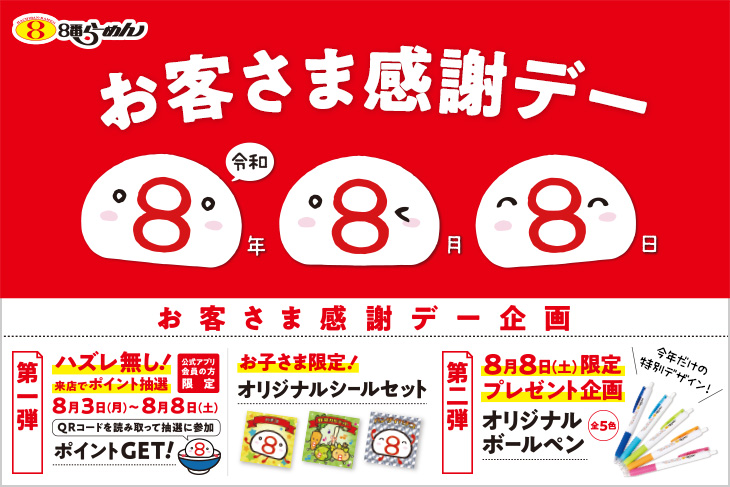
In the Japanese calendar, 8 August 2026 was Reiwa 8, month 8, day 8 — three eights in a row, a date that occurs only once in the Reiwa era.
Brands across restaurants, utilities, railways and department stores launched “8” promotions simultaneously, and the trade press AdverTimes covered the phenomenon as the “888 Sales War.”
Tsukiji Gindaco, a takoyaki chain, upgraded its existing “Gindaco Day” for this year only: the first 88 customers could buy a boat of 8 takoyaki for 88 yen. Digital stamps were tripled. Headcount, portion size and price were all set to eight.
Spaghetti chain Pancho renamed its annual “Pancho Day MAX” to “Mega MAX,” selling an 888-gram portion for 888 yen for one day only, with in-store perks tripled. On X, eight people won a year of free toppings and 88 won meal vouchers.
Railway operator Meitetsu released a product that went on sale at 8:08:08.
Why it worked
Three reasons.
First, the justification for the discount was not “it’s cheap, please buy” but “the numbers line up.” The 88-yen price is the result of wordplay, not a margin calculation. That removes the whiff of a fire sale and replaces it with a sense of festival.
Second, every single variable was governed by the number. Not just the price — headcount, portion count, grams, launch time, even the multiplier on loyalty perks. When every number matches, the alignment itself becomes the joke, and no explanation is needed.
Third, it happened across industries on the same day. Alone, any one of these is a minor gimmick. Because restaurants, railways and department stores all moved together, the media created a frame — “the 888 Sales War” — and every participant rode that coverage for free.
Note too that each brand already had a recurring event. They simply upgraded it for one year, which kept cost and preparation to a minimum.
How a smaller company can use this
Find a numerical coincidence hidden in your calendar, address, company name or founding year. Then refuse to use it as an excuse for a discount, and instead make it the design rule that governs every variable in the campaign.
Headcount, quantity, price, time of day, perk multiplier. When they all share the same number, the alignment becomes the entertainment. And the more competitors join on the same date, the more media space is created — everyone wins.
▷ How we would use it
Start by auditing the numbers in a client’s founding year, name, address and phone number, and build one “◯◯ Day” out of them. For a demolition or waste business, 30 May works (in Japanese, 5-3-0 reads as “gomi zero,” or zero waste). Limit it to 53 companies, price the plan at 530,000 yen, open registration at 5:30 — everything set to 53.
What matters is replacing the reason for the discount with “because the numbers lined up.” The amount you concede is identical; only the reason changes, and it turns a markdown into an event. Repeat it once a year and within a few years it becomes “our day.”
In short
The 888 Sales War was not a lesson in how to cut prices. It was a lesson in how to manufacture a reason to cut them. Find the numerical coincidence, then run it through every variable in the campaign. The same discount becomes a festival.
At ASTER we break down more than 100 notable campaigns to their structure and translate them into customer acquisition and recruiting for your business. Is there an unused “◯◯ Day” sitting inside your own numbers?
(Structural breakdowns and a case archive are available on request. Please get in touch.)