“Same ingredients, lower price.” Every brand says it, so nobody believes it. Instead of saying it, The Ordinary put a banana on a shelf for $175.
What happened
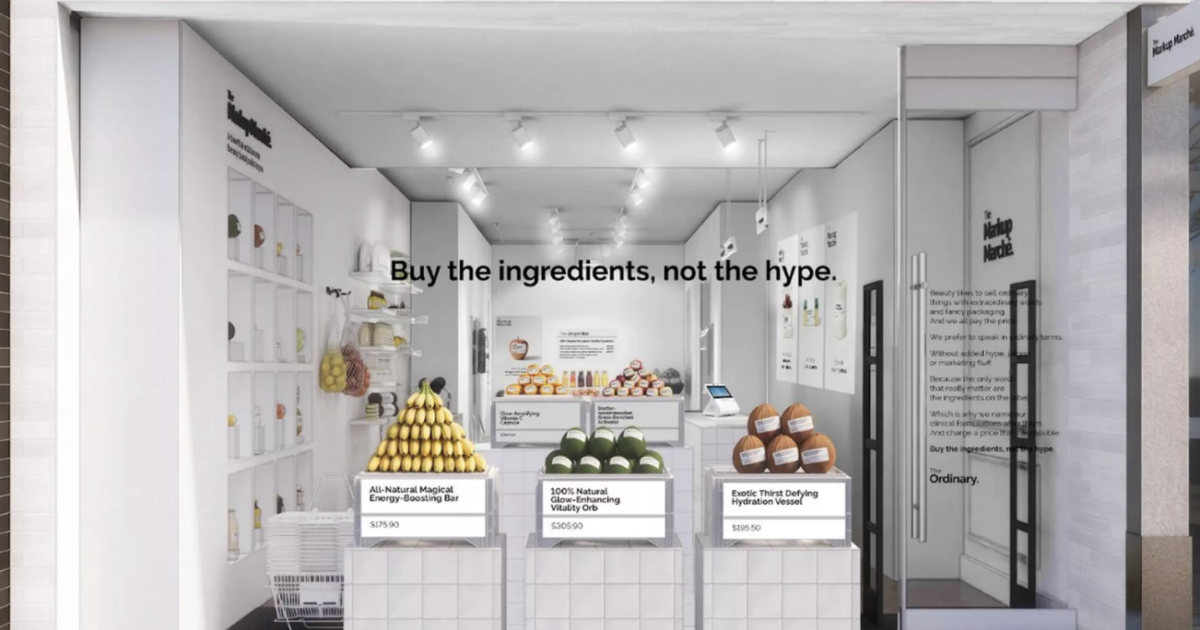
In May 2026, skincare brand The Ordinary opened a fake luxury supermarket called The Markup Marché in Toronto, then toured it to London, Paris, Melbourne, São Paulo and Mexico City.
The shelves hold ordinary groceries. Only the names and the price tags are different.
A banana becomes an “All-Natural Magical Energy-Boosting Bar” at $175.90. An avocado is a “100% Natural Glow-Enhancing Vitality Orb” at $305.90. A coconut is an “Exotic Thirst-Defying Hydration Vessel” at $195.50.
None of it is actually for sale. At the checkout, visitors walk out with The Ordinary’s real skincare instead.
The target is clear: the beauty industry’s habit of taking simple ingredients and multiplying their price with grand language and premium packaging.
Why it worked
The Ordinary took the exact rhetorical move it wanted to criticise and applied it, unchanged, to a completely different category — supermarket produce, where everybody already knows the price.
Show the process by which a banana becomes $175, physically, and the argument that “price can be manufactured out of words and packaging” proves itself with zero explanation.
Using items whose cost the audience already knows was the decisive choice. With a banana or an avocado, the scale of the exaggeration registers instantly. You may not be able to judge whether a serum is fairly priced, but anyone can see that $175 for a banana is absurd.
By relocating a critique of the cosmetics aisle into a supermarket, an industry argument became a joke that works on people outside the industry.
It is efficient, too. Price tags and copy are all it takes, which is why it could tour six cities. And handing over real product at the checkout closes the satire into a sales route.
How a smaller company can use this
Take the rhetoric you want to criticise in your industry — the exaggeration, the pricing, the jargon — and transplant it wholesale onto a category where your customer knows the going rate. Then make it physical as a parody aisle and set of price tags.
Applied to something whose cost people know, the absurdity of the exaggeration lands without explanation. And the critique becomes a joke that outsiders can follow.
▷ How we would use it
This is the cheapest structure on this list to borrow. You do not need to build a shop; one sheet of paper will do.
Translate a set of competing web-development quotes into a ramen shop menu. “Special broth adjustment fee: ¥80,000.” “Noodle count optimisation: ¥120,000.” Apply the same rhetoric to ramen and the customer understands in a second.
Renovation, insurance, telecoms — any industry where jargon inflates the price. Rather than explaining how honest your own quote is, one page translated into another industry does the job faster.
In short
The Ordinary showed that the shortest route to criticising an industry’s exaggeration is to transplant its rhetoric into another industry. Applied to something whose price people already know, the exaggeration looks absurd without a word of explanation.
At ASTER we break down more than 100 notable campaigns to their structure and translate them into customer acquisition and recruiting for your business. How does your industry’s “normal” look from the outside? Let’s translate it together.
(Structural breakdowns and a case archive are available on request. Please get in touch.)