You can’t partner with a competitor. Suppliers come with strings attached. So who is left? The answer was: a company with nothing to do with you at all.
What happened
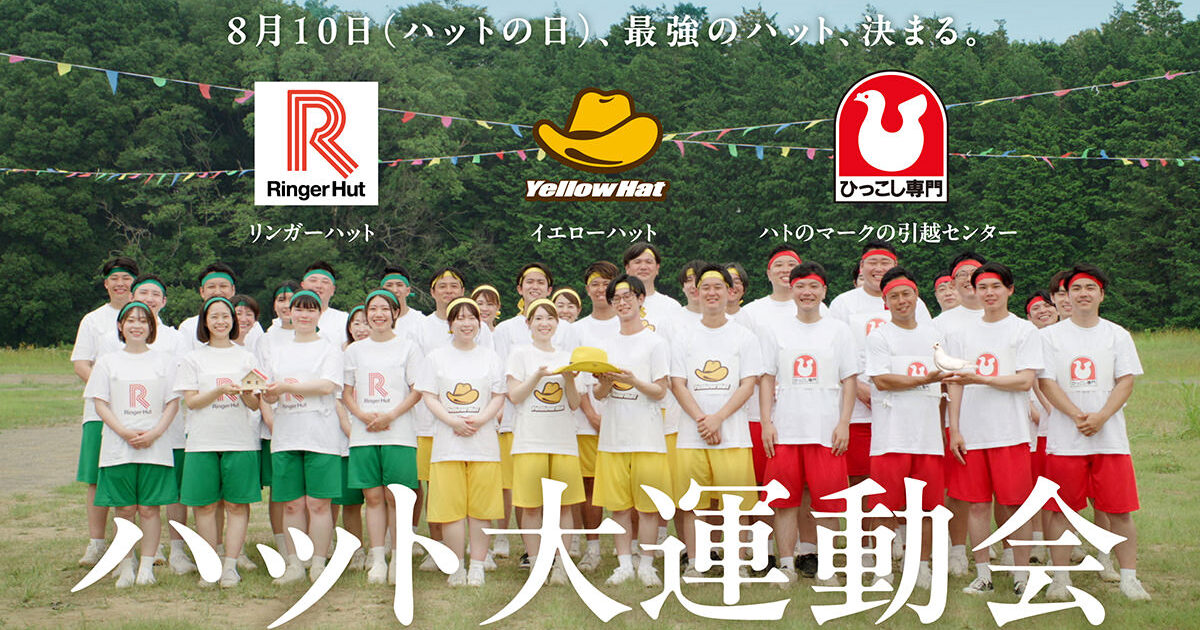
In Japan, 10 August is “Hat Day” (8-10 reads as ha-tto). Ahead of it, three companies form an alliance: Yellow Hat (car parts), Ringer Hut (restaurants) and Hato no Mark Moving Center (removals) — joined in some years by Pizza Hut Japan.
The reason they formed it: their company names all contain “hat.” That is the entire rationale.
Since 2022 they have published an annual online film of a “Hat Summit” in which the presidents of each company meet. In 2025 they changed the format for the first time, staging a “Hat Sports Day.” Twenty-five employees across the three companies competed in the spirit of “hat-manship,” with tyres, contract farmers and an actual pigeon appearing as helpers.
Guests included employees of Red Hat, a man surnamed Hattori, and a Korean cheese hotdog vendor. Each company ran its own parallel campaign: a follow-and-repost giveaway for a three-way co-branded tracksuit, and Ringer Hut handing meal vouchers to 810 winners.
Why it worked
The three businesses share no category and no trading area. That is precisely why the arrangement holds together.
Because they are unrelated, they are not competitors. Because they are not competitors, each can promote the campaign to its own customers without a conflict of interest. And because three customer lists and three social followings are pooled, one company’s budget buys three companies’ reach.
“Why these three?” is the hook that carries the sharing. It needs no explanation to land.
Above all, they repeat it. By evolving the format — from a presidents’ summit to an employee sports day — a one-off idea has grown into an annual fixture that stays fresh despite being expected.
Invented vocabulary like “hat-manship” does real work too: it is silly, yet it conjures a world with its own rules.
How a smaller company can use this
Form an alliance with companies in entirely unrelated fields, on the sole basis that a name, place name, number or founding year matches. Then repeat the joint campaign every year until it becomes an annual fixture.
Because you are unrelated, interests never clash, and you can pool the customers and followers of every participant. One company’s budget delivers reach multiplied by the number of partners.
▷ How we would use it
For regional SMEs, gather three businesses from different sectors whose names share a character. A builder, a hair salon and a car workshop — the mix can be arbitrary. In fact, the more arbitrary the better.
Three companies founded in the same year become the “Same Age Alliance”; three in the same neighbourhood become the “◯◯ Town League.” Once a year, shoot a single film with the three owners side by side and release it simultaneously on all three social accounts. You pay for one film and get three companies’ reach.
The critical part is not stopping at one. Do it three years running and it becomes “that thing they do every year.”
In short
The Hat Alliance proves you do not need to find collaborators by industry. A matching name is enough. Being unrelated is what prevents conflict, and repetition is what turns it into a fixture.
At ASTER we break down more than 100 notable campaigns to their structure and translate them into customer acquisition and recruiting for your business. Shall we look for the partners hiding in your name, your numbers, your town?
(Structural breakdowns and a case archive are available on request. Please get in touch.)