Saying “we’re cheaper” convinces nobody. So show people, physically, what eating at the competition costs. Chili’s picked a site right next to a McDonald’s.
What happened
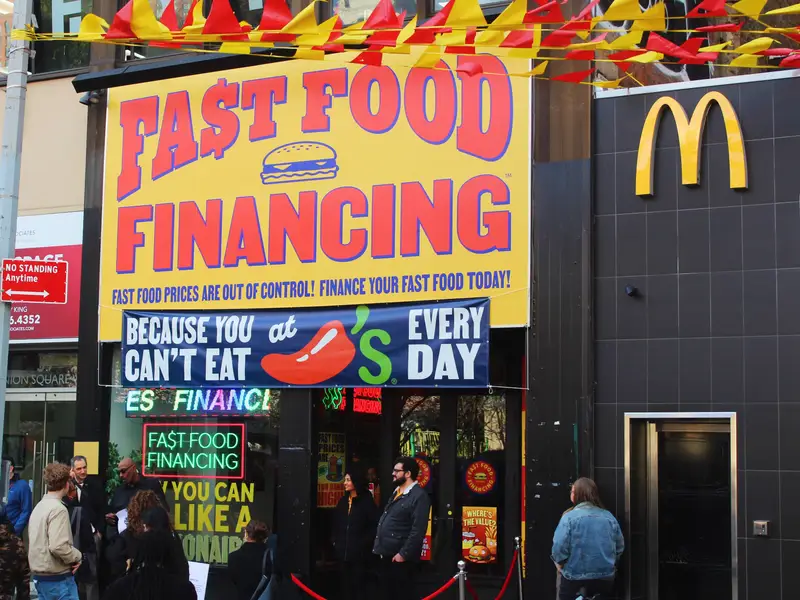
On 16 and 17 April 2026, Chili’s opened a fake payday-loan storefront called “Fast Food Financing” immediately next door to a McDonald’s in New York’s Union Square.
The exterior was deliberately garish: “Fast food prices are out of control! Finance your fast food today!” and “Now you can eat like a trillionaire,” plastered across the frontage and set against the sleek McDonald’s beside it.
Visitors went through an “application.” Once “approved,” they received a $20 gift card, and a “vault” at the back opened onto a speakeasy-style room where they could try Chili’s 3 for Me menu — including the Big QP, a burger built to take on the Quarter Pounder.
The result: three-hour queues and over six billion earned impressions.
Why it worked
Chili’s never attacked its rival’s prices with numbers. Instead it took the exaggeration — “you’d need a loan to eat there” — and built it as a real shop.
The argument is carried by physical adjacency and a parody of a business format, not by comparative copy. Because the location next to McDonald’s is itself the punchline, a single photograph tells the whole story.
The choreography is smart too. Application, approval, vault, hidden room: that sequence turns a plain giveaway into a game people want to enter. Three hours in the queue reads as participation, not waiting.
And the gift card was usable at any restaurant. That generosity neutralised the meanness into humour. The brand attacks a competitor without leaving a bad taste.
The two-day-only format matters as well. It keeps the physical build cost minimal while maximising coverage.
How a smaller company can use this
Instead of comparing your competitor’s weakness in words, build the service that would have to exist if that weakness were true — as a real shop or counter, played as parody — and place it right next door.
A physically built exaggeration draws less blood than comparative advertising. One photo carries it, and the choreography (application, approval, secret room) is what creates the queue.
▷ How we would use it
At a trade show, dedicate one corner of the stand to a parody counter. Put up a sign reading “Competitor Price Financing Desk” and staff an approval window. That single counter gets photographed far more than any chart attacking competitors’ quotes.
For a local retailer, run a one-day pop-up near a competitor. “Rest stop for people waiting at ◯◯” works fine. The trick is to aim for laughter rather than attack.
The essence is to build the exaggeration rather than state it. The same claim becomes news the moment it exists as a physical object.
In short
Chili’s translated comparative advertising into architecture. Rather than describing a rival’s weakness, it built the world that weakness creates. No bad blood, one photograph to explain it, and a queue around the block.
At ASTER we break down more than 100 notable campaigns to their structure and translate them into customer acquisition and recruiting for your business. Shall we work out how to turn your competitive advantage from a sentence into an object?
(Structural breakdowns and a case archive are available on request. Please get in touch.)